Guyana Community of Practice launches with a national dialogue on leadership that cares
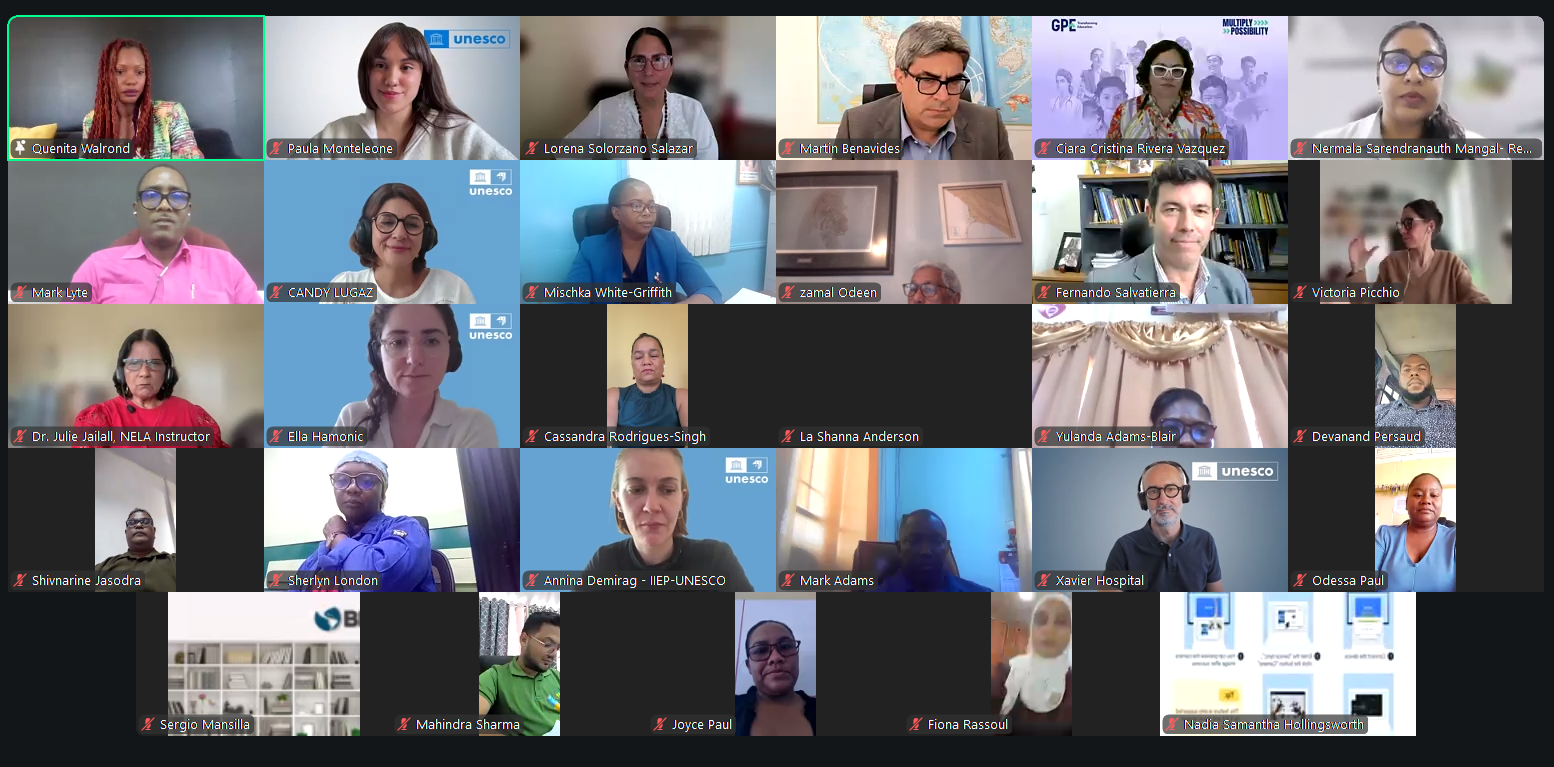
The launch of the Guyana Community of Practice brought together 242 participants from across Guyana's education community to begin a new national space for shared learning, mutual support and collective action for safer and more inclusive schools.
Held online on 14 September 2026, the event connected education leaders, teachers, regional officers, families, learners and development partners under the theme “Leadership that Cares: Safer and More Inclusive Schools in Guyana.”
A new space for collective action
The Guyana Community of Practice is an ongoing space where experience from Guyana's schools and regions can inform practical professional learning and collaborative action. The initiative is supported by the Global Partnership for Education, the Inter-American Development Bank and UNESCO's International Institute for Educational Planning.
Opening the event on behalf of the Ministry of Education, Ms. Mischka White, Chief Planning Officer, placed safety, respect and belonging at the centre of the Community's purpose.
“Every student deserves to enter the school gate knowing that they are safe, respected, valued, and seen. Today, we're not merely launching a community, but a national movement.”
Leadership begins with listening
The opening dialogue placed Guyanese experience at the centre. A regional education officer, school practitioners, a parent representative and a student described how safety, trust and belonging are strengthened through daily decisions, responsive communication and meaningful participation.
“Safer schools are created by stronger relationships.”
La Shanna Anderson · Regional Education Officer, Region 10
Rules alone are not enough. A learner experiences belonging when the learner can say: “I am safe here, I'm respected here, I am supported here.”
Creating space for learners to speak
Joel Mcphoy · Senior Master, Queen's College
An approachable school adult can help a learner come forward without being immediately judged or shamed.
Clear and timely communication with families
Nadia Hollingsworth · National PTA Coordinator
Trust between schools and families depends on communication that is clear, timely and supported by responsibilities understood on both sides.
“Mutual respect isn't built on token seats at the table.”
Abhivir Singh · Student Council President, Queen's College
Student participation must be structural and able to influence school governance, rather than being treated as a symbolic formality.
Taken together, these contributions showed that school safety is not the responsibility of one role or institution. It depends on coordinated leadership and on the inclusion of the people most directly involved in school life, including learners themselves.
From care to action
Dr. Mark Anthony Lyte, an instructor with the National Education Leadership Academy, connected the local accounts through a practical principle for the new Community: “Leadership that cares is leadership that acts. Care must be translated into responsible action.”
Xavier Hospital, Team Leader for Safe and Healthy Schools and Data at UNESCO, presented a whole-school approach spanning curriculum, school climate, reporting mechanisms, policy, partnerships and data. Prevention, he stressed, requires action at several levels of the education system.
María Fernanda Prada Patiño, Senior Education Specialist at the Inter-American Development Bank, highlighted the importance of adapting evidence-informed programmes to context. The examples presented included an intervention that reduced teacher-to-student physical violence by 42 per cent in less than eight months.
Safer and more inclusive schools are built through the decisions education leaders make every day, the support they receive, and their ability to learn from one another.
Candy Lugaz · Programme Specialist, UNESCO International Institute for Educational Planning
A community shaped by its members
The Guyana Community of Practice welcomes school and district leaders, teachers and other school staff with leadership responsibilities, education officers, aspiring leaders, Ministry officials, students, families and community members from every region of Guyana. Including learners is essential to the Community's commitment to meaningful student voice rather than symbolic participation.
The Community complements the National Education Leadership Academy, whose first cohort of 100 leaders began training in December 2025 and continues through July 2027. It connects formal leadership development with the knowledge, challenges and practices emerging across Guyana's education system.
Family engagement
The leading priority identified during the launch.
Prevention and school culture
Shared strategies for safe and inclusive environments.
District coordination
Stronger links across schools, regions and the system.
Digital safety, staff capacity and learner voice
Further priorities to be validated through the needs assessment.
What happens next
Members are invited to join the platform, complete the needs assessment and encourage colleagues across schools, regional education offices, families and student communities to participate. The Community's agenda, formats and schedule will continue to be developed through consultation with its members and grounded in the realities of Guyana's regions.
“The detailed agenda, the formats, and the priorities of the Community will be shaped through continued consultation with you, its members.”
Closing the launch, Candy Lugaz thanked the Ministry of Education, the Global Partnership for Education, the Inter-American Development Bank, IIEP-UNESCO, all speakers and the 242 participants. The next phase will focus on growing the Community as “a space for shared learning, mutual support, and collective action” in support of safer and more inclusive schools across Guyana.
Watch the launch
Revisit the national dialogue that marked the beginning of the Guyana Community of Practice.